
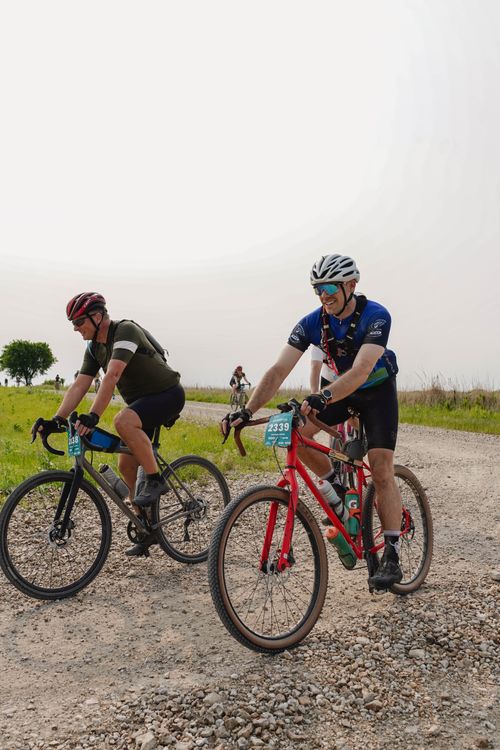
First, this is an incredible event from start to finish. The community here is amazingly supportive and encouraging of the riders, and the athletes here are supportive of one another, regardless of distance. This year's event had representation from all 50 states and 47 countries, so it certainly does appear to live up to the hype as the "Super Bowl of Gravel." Many of you have already mentioned looking forward to next year's events. For you gravel enthusiasts, I would put this at the top of the list.
I didn't know what to expect heading into this one. Other than back-to-back long days riding the Kokopelli trail in April, my longest training rides were in the 2.5 - 3 hour range. So I went in leaning on historical fitness and hoping I'd find some groups to ride with. I had no idea what to expect for a time goal given the nuances of Unbound, so I wasn't really focused on anything specific. My main race day goals were to find groups to ride with, stay on top of nutrition, enjoy the experience, and see how it played out.
The first 20 miles of this were proper hot. We lined up near the front and took off in a group of around 200 people, with an average pace of 22mph through 20 miles and 20mph through 38 miles. A pack this big is always dangerous, and we had to focus on communicating effectively and holding lines. Unfortunately, there was a whole mess of crashes in the first 15 miles, and a lot of carnage in general for the first 90 minutes or so.
My power meter seemed to mirror the chaos of the pack and was not picking up consistently for the first hour. It would drop in and out and I had no power data to know just exactly how hard we were going. I could tell by heart rate and effort level that I was within reasonable limits, but there were a lot of surges and moves to cover. Given the chaos of the group and the need to keep eyes focused, I had no opportunity to reset my power meter with my head unit and was left using the rate of perceived exertion as my guidepost. This remains one of the most valuable lessons from the day. Learning how to gauge effort on feel and feel alone is critically important for race day. Should you find yourself in a situation in which you do not have access to data, you will need to have a reliable sense of that fine line between sustainably hard and too much. You also need to know how to troubleshoot and get your power meter and/or heart rate monitor re-connected with your headunit while riding. Once I had a safe window, I was able to disconnect and re-enable my power meter with my headunit and was good to go the rest of the day.
I rolled into the neutral aid station with a group of 3 at mile 54 and did my best to be as efficient as possible. The hired crew at this aid station was massive and well organized, but the neutral aid was not well-marked and it took a few minutes to figure out where I could top off my bottles.
I was lucky enough to hop into another strong group and we were clicking off the miles until mile 80 when the Flint Hills led up to their name and I flatted. This is lesson number 2. Learning how to fix a flat, plug a tubeless tire, and fill it back up is crucial in these events. The technology of flat repair is incredible these days, and with the right knowledge, you can be back on your bike very quickly.
The downside of the flat was that I was left riding solo for the final 28 miles. I still had enough energy in the tank and rolled a tempo pace back into town and made a deliberate decision to enjoy the remainder of the ride. Pedal time 5:48 with an official event time 5:57. For those curious, for the final 4:40 in which my power meter worked consistently, this was a 3300kj effort with an NP average of 2.54 w/kg.
Nutrition, by the numbers:
I brought enough for 7 hours, having no idea how long I was going to be out there:
Never2 Gel at the start (30 g)
2L USWE filled with 300 grams of Skratch High Carb (21 scoops for those of you counting)
2 large bottles with Maurten 320 (160 g), refilled at mile 54 (one with water, the other with Maurten 320 - another 80 g)
2 NeverSecond gel flasks that hold 4 gels each (240 g total). I've come to love these gel flasks, mainly because I can't stand the sticky mess of unwrapping gels while riding. Couldn't recommend these more.
I also took a little red ambulance (small Coke) hand up from a spectator 2 miles after my flat adding an unplanned 25g. This was a great moral boost.
Caffeine: 521 mg (I used 4 neutral caffeinated gels at 75 mg each. 2 Maurtens each had 100mg each. Little Red Ambulance at 21 mg).
I didn't drink my entire USWE, but I ended up somewhere close to 610 g/cho for the day (a touch more than 100 g per hour).
We hope you found this recap helpful and our team is looking forward to seeing you next month in Emporia – good luck riders!
– Dr. Justin Ross, Endurance Coach and Human Performance Psychologist
April 21st, 2026