
This article, written by Boundless Coach Colleen Miracle, was originally published to Outside RUN in April 2024.
Ultrarunning is a way of life, and perhaps a bit more of an expensive one than its granola-crunching vibe might lead one to think. Here’s a breakdown of why this fast-growing sport can cost thousands of dollars per race, and how you can cut costs without cutting corners.
_______________________
Race entry fee: $350. Cost of two pairs of trail running trainers: $320. OK, now to just calculate flights and a hotel. Do I need to rent a car, too? How will I get transportation to the race? Oh shoot, I forgot about paying for a dog sitter. Is my grocery bill usually this high?
Those are some of the thoughts that ran through my head when I calculated the cost of running my first 100-mile trail race. After completing more than 16 ultras, I’ve discovered the costs of these ultra-long-distance races extends far beyond just the race entry fee. Extra groceries to meet caloric needs, physical therapy, gas driving to trailheads…the list adds up quickly.
Don’t get me wrong: once I got bitten by the ultra bug, I knew I was in for the long haul, and every dollar I spent would be an investment in myself. But let’s face it, ultrarunning can be an expensive endeavor.
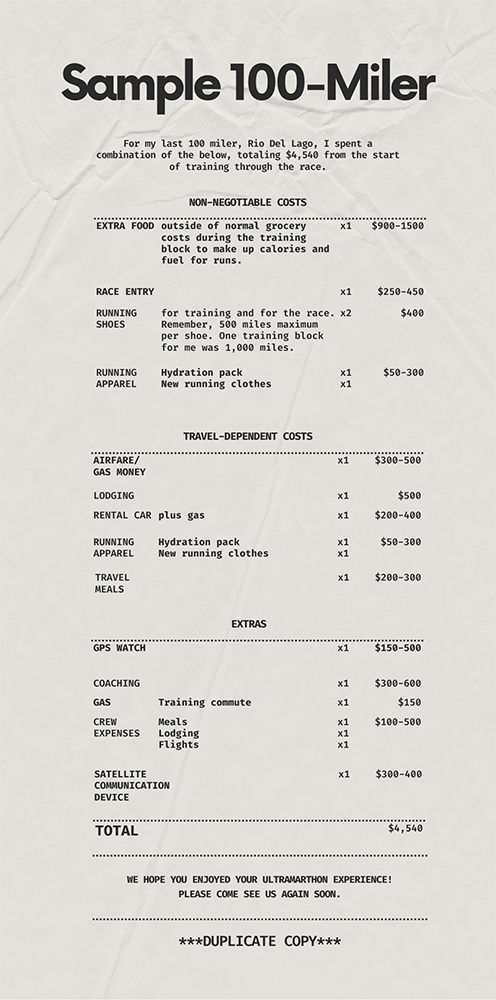
I backtracked my expenses over the past three years of training for these races and found that I pay $3,000-$4,500 for each 100-mile race and training block and $1,700-$2,000 on average for each of my 50K and 50-mile races and training blocks. As a middle-class millennial who likes to run a few races per year, this requires some financial planning. When I first got started in the sport, I wish I’d had a breakdown of costs I could expect. So, I tallied up the receipt from my last 100-miler, Rio Del Lago. The price tag: $4,540, from the start of training through the end of the race. (Scroll down to see an itemized list of possible expenses you should be aware of as you approach a 100-mile race.)
Ask any ultrarunner and they’ll gladly tell you that the mountain views, friendships, and experience during ultras feel priceless in the moment. I can’t deny it, I’m not thinking about my wallet when I hobble across the finish line and reach out for that prized finisher’s belt buckle or see the stunning, glowing orange sunrise on the second morning of a race. However, it’s worth considering where and how you’re spending your hard earned dollars on this elective lifestyle we call ultrarunning—and where you can cut costs without cutting corners.
‘Ideal’ Versus ‘Doable’ Budgeting
While the numbers above may seem intimidating, don’t fret; there are ways to cut costs and budget responsibly. You may just need to adjust your expectations depending on your financial situation. Opting to run regional races that don’t require travel and limiting non-essential gear purchases are ways to save money while still being fully invested in ultrarunning. Or you can spend an entire season simply doing the most epic long trail runs in your region without racing at all.
“I wouldn’t encourage an individual with large amounts of debt and no savings or retirement to sign up for a costly ultra,” says Candace Bryans, MBA, a financial analyst, business owner, and ultrarunner based in Buena Vista, Colorado. “There are plenty of low-cost online training plans and backyard ultras for someone to join in as they work towards having the additional income to participate in their ‘ideal’ event.”
Bryans, who proudly shares that she was once a “dirtbag athlete” on a tight budget, explains that it’s always worth revisiting your priorities before you get excited to sign up for that next ultra.
Priorities look different for every person, and especially for younger generations, spending money on recreation can be valued more than saving for large investments like a house. Regardless of priorities, Bryans recommends creating a “50/30/20” budget. 50 percent of your income goes to needs, like mortgage/rent, utilities, bills, food; 20 percent to savings; 30 percent to extras and wants. She also recommends considering a multi-year plan to give yourself time to save up for your ideal race.
“If you have limited funds, pay your bills and put savings and retirement funds back first,” she says. “Then, extra funds from a side hustle can be allocated to fun items, like ultras, travel, or new gear.”
Ways to Save
While you can’t scrimp on certain ultramarathon costs for training, like groceries, shoes, or surprise health costs like physical therapy, other variables aren’t always necessities. For certain races, you can bring your tent and camp before and after the race; just keep in mind you may be risking quality of sleep before and after, which could affect performance and recovery. Your child may be able to stay with your parents or trusted friends. You may be able to pick up a hydration pack and running clothes secondhand or from a friend. You may volunteer at a race and receive a free entry. (Score!)
If you’re fast enough, you can also look into offsetting your costs with a sponsor or racing team. While a few elite ultrarunners have sponsorship backing that allows them to make a living at the sport, mid-level ultrarunners receive smaller sponsorships in the $10,000 to $30,000 range plus prize winnings, which can cover the cost of many racing and training costs. Some athletes are part of racing teams that can help offset the costs of competing at destination races. At most, the latter would save about $500-1,500 per year on race entries, depending how much you race.
If you want to save money, you have to realize what you’re sacrificing. If you’re a mountain runner that runs alone, you run the risk of not being able to contact a safety team in the case of an emergency if you’re without an InReach or similar tracking device. On the topic of gear, you don’t need the biggest and best watch, but you probably want a watch to monitor heart rate, especially a GPS watch to make sure you stay on course and don’t get lost.
Many runners seek experienced coaches to help them achieve their running and racing goals. Especially for high-mileage training blocks, the risk of injury can be higher without a personalized training plan. I trained for my first few 50K races without a coach, but felt more comfortable training for my 100-mile races with the support of experienced coaches so I wouldn’t get injured.
Your plan might look like a combination of approaches, based on your interests and budget, but there isn’t a singular way to go about it. It’s up to you to design your experience given your financial flexibility.
Investment and Risk
Jubilee Paige, race director at Aravaipa Running, is in her eighth season with the racing event company and knows firsthand about the investments racers make.
“If you view ultrarunning from the lens of investing in oneself, daily training, and dedicating time for personal growth, it’s an invaluable practice in self-care,” she says. “In terms of time and money, the more individuals push themselves or the longer the distance, the greater the costs are incurred across all aspects of the sport. As an organizer, I’m aware of the substantial costs involved in hosting these races as the sport gains popularity. However, I think the experience can also be determined by personal choices, like choosing to drive or fly, dine-in or ‘brown-bag-it’, camp or book hotels.”
While I don’t wish this on anyone, it’s prudent to budget for any unintended costs—namely injury. This physical risk that trail ultrarunning demands is different from road running, and there are, of course, road ultras you could consider. I find myself praying to the ultrarunning gods the morning of race day that I won’t trip over a giant boulder in the trail or faceplant on a slippery tree root. During the Leadville 100 last year, I saw a man slip just ahead of me on the gravel-ridden downhill of the Powerline section and break his elbow. You can’t plan for injuries, and they’re even more disappointing when you’ve spent thousands of dollars leading up to race day.
Ultrarunning Brings Long-Term ROI
For me, even if it can be expensive, committing to the ultrarunning lifestyle is, without a doubt, worth it. My advice for newcomers is to enjoy the ride, but know that it’s a long-term endeavor that doesn’t always bring an immediate return on investment. There are a lot of experiences that you can’t put a price tag on and actually appreciate in value over time. Nothing compares to the “firsts” in this sport—your first trail run, first ultra, first belt buckle, first aid station Coke, etc.
The ability to run through the woods on nothing but a dream for 24 hours isn’t for the instant-gratification type. You’ll experience a journey through highs and lows in ultrarunning, learn how to push past what you physically thought was possible, and create memories on the trail that only you will value for years to come.
As the dedicated and social-media savvy ultrarunner Andrew Glaze likes to say, “Smile or you’re doing it wrong.” Don’t forget to take it all in.
One of my greatest pieces of advice is to keep perspective when you’re engulfed in the sport. Race day is just one day in the bigger journey of this lifestyle. If something comes up, you can likely defer your race entry to the next year, or there’s another race option to look at later in the year.
Ultimately, there’s a ton of privilege in this sport. Running for leisure, spending time driving and flying to races, and trotting for hours on new trails are luxuries to many parts of the world. If .01 percent of the world population has run a marathon, that puts our community under a pretty niche lifestyle category.
Hidden ultramarathon costs shouldn’t deter you; my goal is to shine a light on the accessibility for everyday runners dipping their (blistered) toes into ultras.
Remember, it’s up to you to design your experience.
-Colleen Miracle, Boundless Coach
May 7th 2026