
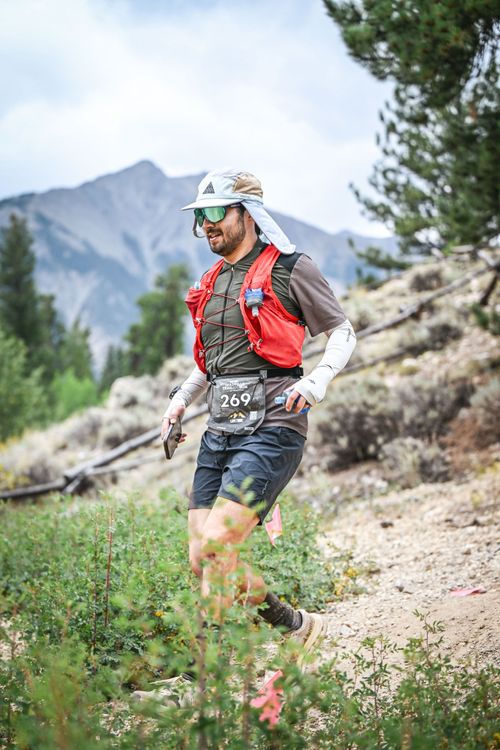
Aaron Dornbrand-Lo - LT100 Run
What motivated you to want to run 100 miles and how did that motivation-drive encourage your training throughout the year?
I'd had the Leadville 100 on my mental radar for 15 years; I first read Born to Run in 2010. The description of the race in the book made it feel completely otherwordly and beyond the reach of all but the most gifted and dedicated athletes. I love mountain sports, exploring, and pushing my physical boundaries and a legendary 100 miler ticked so many of those boxes for me.
What surprised you most about having a coach?
I really underestimated how much more there is to training than just a workout plan. There's so many intangibles that went into my Leadville build from figuring out nutrition and logistics to figuring out a race calendar that kept me motivated and ready to peak for my A race to working on my mental fortitude for race day. Fitness is necessary but not sufficient for running 100 miles; Coach Ben helped me figure out all of the other components that I needed to put in place.
Can you describe a moment in training or racing where you were unsure of your ability to succeed? How did you overcome your doubt?
The second climb over Hope Pass was the worst I've ever felt physically. I knew I was behind on my nutrition and fluids, but my stomach had completely fallen apart and I could barely manage a few small sips of water. The sun was beating down on me and I kept slipping back down the steep dusty trail. I felt worse and worse as I trudged upward into the high alpine. More than anything this was the moment where Ben's coaching and guidance paid off. There's no way that the exhausted, dehydrated version of me deep into a bonk could have dragged his burning legs through the remaining 45 miles of the race. But Ben and I had talked through mental strategy and had debriefed enough prior blowups and had planned out enough scenarios for me to focus on grinding into the next aid station so that I could start problem solving. 10 minutes of sitting and methodically working through every nutrition item there and I started to feel human again. I was able to pick back up and run downhill and start drinking again. By the time I made it down to Twin Lakes I knew that if I relentlessly focused on solving each problem that arose that I could grit out a finish.
I don't think there's any point where I didn't look at a 100 mile run without being filled with doubts and insecurities. Working with Ben helped me develop the skills, fitness and confidence to take on steep climbs and drop bag organization and long gaps between aid stations and variable weather and mentally resetting and a million other things. He helped me figure out how to turn a big, intractable problem into a bunch of pieces that I did know how to manage. I was always chasing some small goal; get to the top of this hill, eat two more gels in the next 30 minutes, change my socks at the next aid station. Almost 29 hours of small victories made crossing the finish line at mile 100 feel like just one more step.
****
You also managed to PR your marathon twice in a year — what role did speed and intensity play in your training?
Incorporating speed and intensity paid huge dividends in my racing at all distances. One part of the training that Ben prescribed for me was being very deliberate at specific speeds and efforts which really helped me develop a feel for different paces and comfortable working hard. I definitely believe you have to run fast to run fast, and having a very clear plan that had me spend a lot of time at quick paces really helped me develop the fitness to improve my race times. Ben's intensity workouts also gave me the confidence to know that I could still keep pushing the pace during the last few miles of a race while my legs and lungs were burning. Intense workouts also had a ton of carry over to ultras when I was grinding up a hill or pushing downhill to beat a crowd into an aid station.
How did coaching impact your level of confidence going into race day?
Having Ben on my team made a huge difference going into race day, especially the first time I lined up at a given distance. Knowing that someone who had the experience of coaching a ton of folks through breakthroughs thought I was ready was a huge boost. The logistics calls and race plans that Ben put together removed a ton of uncertainty on race day and made me confident that I would have the gear, nutrition and crew organization that I needed to keep me moving.
Looking back on the past year, what’s the single biggest thing you learned about yourself as an athlete and as a person?
It's almost cliche that you learn how deep you can dig when you run Leadville, but I have to say I've never been prouder or more impressed about my own ability to push myself after that race. I learned how deep my reserves are bit by bit with each race and hard training block, but really uncovered them on the backside of Hope Pass. I also took it really easy training wise after finishing Leadville but still managed to PR in the New York Marathon by tapping into the fortitude I had uncovered.
If another athlete were considering coaching for the first time, what would you tell them based on your experience?
I could not have had nearly as ambitious or successful set of races without a coach. I'm a working professional with constrained time to train and I live in a city with limited access to mountains. Having a coach is such a force multiplier that will really let you maximize what you're able to accomplish with the time and trails you have.
– Aaron Dornbrand-Lo (Coached by Ben Davis)