
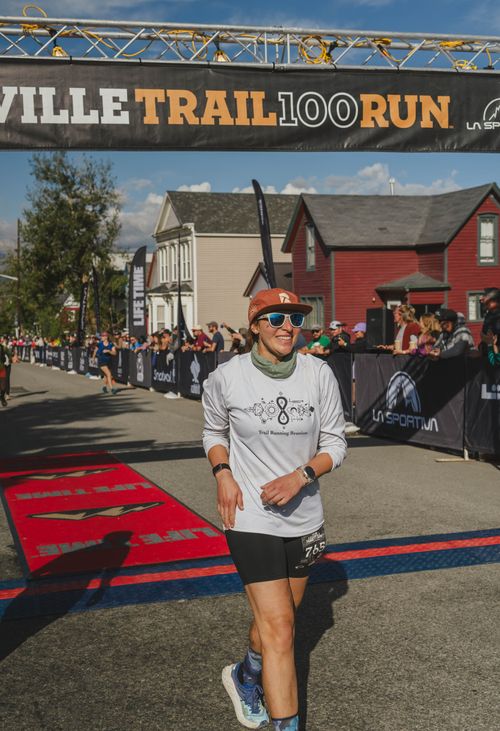
The final three miles of the Leadville 100 were some of the most emotional miles I have ever run.
My husband, JJ, was filming a short clip and asked me how I felt. I tried to answer, but I couldn’t get the words out without crying. There was only one thing I wanted to say:
“Paw Paw, I finally did it.”
In those final miles, I could see my grandfather’s face and his smile. He had always been one of my biggest cheerleaders, and I felt like he was with me, leading me toward the finish line.
It had taken me three attempts to get there.
And that made the finish mean even more.
This Wasn’t My First Time Here
My first attempt at the Leadville 100 was in 2021.
At the time, I was living in Texas and working my way through ultramarathons trying to prepare myself for a 100-mile mountain race in Colorado. I genuinely thought I had done everything in my power to prepare. I had trained hard. I had accumulated miles. I even bought an altitude tent and slept in it for more than a month trying to prepare my body for Leadville’s elevation.
I made it 40 miles.
Looking back, I had worked hard, but I had no idea how much more this race required of me.
My second opportunity came after I moved to Colorado. I earned a Leadville entry after winning a coin at another race, and I thought this time would be different.
I trained. I worked hard. I was stronger.
I made it 60 miles.
That one hurt.
There wasn’t a dramatic injury. There wasn’t a major GI problem. Nothing catastrophic happened during either attempt.
I simply wasn’t mountain-fast enough.
That was difficult to accept, but it also gave me clarity. I knew I had more in me, and I knew I wasn’t finished with Leadville.
What the DNFs Taught Me
Those two DNFs taught me more about myself than an easy success ever could have.
They showed me that I am resilient. They showed me that I have grit. But they also forced me to be honest with myself.
Wanting something badly wasn’t enough.
I needed to become better.
I needed to push harder during speed work. I needed to build a bigger aerobic engine. I needed stronger mountain legs. Most importantly, I needed to stop believing that simply working hard meant I had done enough.
There was another level of preparation available to me. If I wanted to finish Leadville, I had to go find it.
What Changed the Third Time
For my third attempt, the training changed.
I incorporated significantly more vertical training and committed to an eight-week VO2-focused block. Once a week, I did hard uphill running sessions designed to build my engine and improve my ability to climb efficiently at altitude.
I also committed to the long runs. I didn’t skip them when they were inconvenient. I didn’t shorten them simply because I didn’t feel like being out there all day.
And somewhere during that process, the long runs stopped being only physical training. They became mental training.
Every time I went out when I didn’t want to, every time I continued when I was uncomfortable, and every time I finished a workout that would have been easier to skip, I was practicing the exact skill I would eventually need at Leadville: continuing forward when my brain was asking me to stop.
That preparation required sacrifice.
There were weekends devoted to training. There was time away from JJ. There were early mornings, long days, tired legs, and plenty of moments when doing something easier would have sounded much better.
But I knew what I wanted. This time, I was willing to prepare accordingly.
The Hardest Hours
One of the hardest moments of the race came between approximately 2:00 and 4:00 in the morning.
I had left Twin Lakes with a roughly four-mile climb ahead of me. I got through the climb, but shortly afterward a different kind of fatigue started to settle in.
I wasn’t just physically tired, I was sleepy.
I remember walking and thinking that I could literally close my eyes and fall asleep while moving. That was when my pacer became invaluable.
We started doing run-walk intervals to keep me engaged and moving. I asked him to stay next to me with his light because the extra stimulation helped me stay awake and focused.
At that point, the race wasn’t about how fast I could run. It was about solving the problem in front of me.
Stay awake. Keep moving. Take another step. That became the theme of the entire race.
Relentless forward motion.
The People Who Carried Me
There is no version of this story where I finish Leadville completely on my own.
JJ has been there through every attempt.
He even ran alongside me during my first two attempts. On this third one, he became my crew leader, problem solver, biggest cheerleader, and the person who believed in this goal alongside me for years.
I could not have done it without him.
My pacers, Chandler and Amanda, were another enormous part of this finish. They have been running with me for several years, and they sacrificed time away from work and family to prepare for this race and be there for me.
Knowing what they had invested in helping me reach this goal meant something.
During difficult moments, the thought of quitting after they had sacrificed so much burned a hole in my stomach. I couldn't give up.
My parents, friends, and family were also cheering from afar. They sent messages and videos to lift me up during the race when I was running low.
And then there was my grandfather. Paw Paw had been one of my biggest cheerleaders.
He wasn’t physically there this time, but there was never a question in my mind that he was part of this race. For him, and for myself, I was going to cross that finish line.
What Finishing Meant to Me
Completing the Leadville 100 is one of the achievements I am most proud of in my life.
I put so much of myself into this race.
The training. The sacrifice. The failed attempts. The early mornings. The long runs. The doubts. The hours spent climbing mountains. The willingness to come back after hearing twice that my race was over.
I’m stubborn. And somewhere along the way, I decided that never finishing Leadville simply wasn’t an option.
Maybe it would take three attempts. Maybe it would have taken four.
But I wanted to know what happened if I kept working.
Leadville taught me that I can suffer. It taught me that I can do something extraordinarily difficult and continue moving when everything in me wants to stop.
More importantly, it reinforced something I believe carries far beyond ultrarunning:
Perseverance will take you a long way, but only if you are willing to pair it with the work.
What I Want My Athletes to Know
As a coach, this experience has changed the way I think about failure.
I want my athletes to understand that failing to reach a goal does not necessarily mean the goal is impossible.
Sometimes it means you aren’t ready yet. Sometimes it means you need another season of training.
Sometimes it means you need to change the way you prepare. And sometimes a race might take you two, three, or more attempts.
Every opportunity to stand on a starting line is still a blessing. But for a monster like Leadville, belief alone won’t carry you 100 miles.
You have to put in the work. You have to climb. You have to run when your legs burn. You have to train when motivation isn’t there.
And eventually, when the race strips everything else away and you no longer want to continue, you have to find a way to take one more step forward.
Then another. Then another. Relentless forward motion.
That is the lesson I will carry into my coaching.
Finally, a Leadville Finisher
After three attempts, I am incredibly proud to finally call myself a Leadville 100 finisher. Crossing that finish line felt like becoming part of a family I had been trying to join for years. And receiving that hug from Merilee?
That was one of the moments I had imagined over and over again. Well, that and getting the buckle.
Three attempts.
Forty miles.
Sixty miles.
And finally, 100.
Paw Paw, I finally did it.
Alyssa finished in 29:06:08.
-Coach Alyssa Rodriguez
October 5, 2026