

Training Outdoors: What Good Workout Files Look Like and How to Achieve Them
Anna Hicks
When you think of structured training do you automatically assume you must ride the trainer or Zwift to get the intervals in? While sometimes this is the most efficient way, it is not necessary to ride indoors to achieve a quality workout! There is a time and place for indoor training such as limited time, bad weather, poor road access or unsafe roads, etc. There is no shame in indoor training but if possible, don’t be afraid to take your training outside!
I see a lot of athletes either avoiding training outside when they have intervals or skipping their intervals because they are riding outside. This blog is going to outline:
1) WHY outdoor training is beneficial
2) What GOOD workout files look like from outdoor training
3) HOW to execute a good workout outside
WHY train outside?
There are many reasons to take your structured workouts outside and the biggest one is 99% of you are going to be racing outside. Other benefits include:
-bike handling skills (balance, coordination, terrain and road surface changes, confidence at speed, descending)
more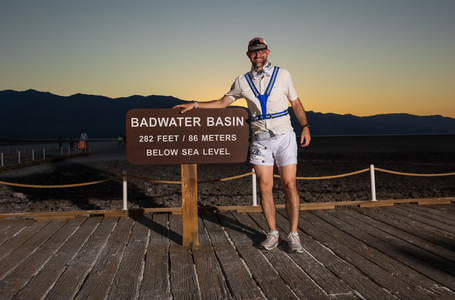
Four Observations from the World's Toughest Footrace
Ben Dicke
Four observations from running the “World’s Toughest Footrace”:
On the Badwater 135 course, your crew becomes your lifeline. It’s estimated that your support vehicle will make up to 100 stops along the race course. The bottle refills, the nutrition tracking, lugging hundreds of pounds of ice, the constant gear management, the lack of sleep is all aimed at one purpose: getting the runner across that finish line.
You’re never alone. The entire Badwater 135 community; volunteers, other competitors, their crew members are all pushing and pulling you towards that buckle finish. It’s humbling and energizing.
You can trust your preparation. This was the most difficult idea to believe as the race approached. Even though I’m constantly reminding the athletes I coach of this concept, it’s often difficult to conceive when you’re approaching a race that you know will ask everything. But the more you trust, the better you’ll perform.
This race is incredible. Every difficult moment, every mountain pass, every valley with blistering triple digit heat rewards you with majestic views and inspiring geological features. From the salt flats of Badwater Basin at 282 feet below sea level to the Portal of Mount Whitney at 8,374 above sea level, the entire course is one long glorious vision.
more

Leadville 100 Race Report and Reflections
Coach Alyssa Rodriguez
The final three miles of the Leadville 100 were some of the most emotional miles I have ever run.
My husband, JJ, was filming a short clip and asked me how I felt. I tried to answer, but I couldn’t get the words out without crying. There was only one thing I wanted to say:
“Paw Paw, I finally did it.”
In those final miles, I could see my grandfather’s face and his smile. He had always been one of my biggest cheerleaders, and I felt like he was with me, leading me toward the finish line.
It had taken me three attempts to get there.
And that made the finish mean even more.
This Wasn’t My First Time Here
My first attempt at the Leadville 100 was in 2021.
At the time, I was living in Texas and working my way through ultramarathons trying to prepare myself for a 100-mile mountain race in Colorado. I genuinely thought I had done everything in my power to prepare. I had trained hard. I had accumulated miles. I even bought an altitude tent and slept in it for more than a month trying to prepare my body for Leadville’s elevation.
I made it 40 miles.
Looking back, I had worked hard, but I had no idea how much more this race required of me.
more
I Became a Coach This Year
Coach Duncan Callahan
I’ve been helping athletes finish the Leadville 100 Run for nearly two decades, and I’ve had my share of emotional moments along the way.
I’ve watched athletes barely squeak under the 30-hour cutoff. I’ve coached several who finished in the top 10, including a couple in the top five, while chasing 19- and 18-hour finishes. I’ve watched athletes transform their lives in pursuit of this goal.
I’ve loved this process for years.
But this past weekend, at the 2026 Leadville 100 Run, something became clear to me in a way it never had before:
I am a coach.
Of course, I’ve known for years that the athletes I work with have goals, that they are chasing those goals, and that I play a role in helping them reach them. But about 20 hours into this race, something happened that I’ll remember forever.
One of the athletes I work with, Nick Walker, was chasing a big buckle - a sub-25-hour finish - in his first attempt at the 100-mile distance.
He had been on pace all day, and we all knew it. Then I received a text from him:
“What paces do I have to hit in this next stretch to hit my goal?”
He sent it from somewhere around mile 75, while he was still running.The fact that he was asking told me he was going to be okay. But what struck me most was how he ended the question:
more
Weighing Life Priorities When Training for a Big Race
Coach Colleen Miracle
You set the goal, you find the race, you click “Register”, and you think, “All that’s between me and this goal is a boat load of training and hard work.” Except, far too often, I’ve noticed it’s easy to forget that there will be a lot of re-prioritizing and life-shifting that needs to occur to reach that goal. And, when a life event or life stress gets in the way, that’s a different challenge entirely.
Let’s talk about your priorities when planning for a race, like a 100 miler:
· Your first priority is to map out how much time it will take to train and dedicate to the training process. This doesn’t just involve how much of your weekdays and weekends are spent running- this is figuring out when you’re going to study your fueling plan, track progress, assess recovery, and plan your race travel. Where will you be spending money on gear? You want to be the most set up for success as you can.
This would be a good time to create a list of your doctors and physical therapists you might use during your training. Make sure you have a close enough relationship with them that you can set up an appointment and get immediate help if something comes up.
more
Leadville 100 MTB Carb Loading Guide & Last Minute Fueling Tips
Coach Anna Hicks
The Leadville 100 MTB is as much an eating contest as it is a race. But did you know the eating contest starts before the race itself?
Carbohydrate loading is one of the most effective ways to improve performance in long endurance events like Leadville. Carb loading increases your muscle glycogen stores, providing more available energy, delaying fatigue, and helping prevent the dreaded bonk.
Many athletes think carb loading simply means eating a huge pasta dinner the night before the race. In reality, it starts 2–3 days before race day. If you've never carb loaded before, keep it simple by increasing the carbohydrate portions of the meals and snacks you already eat by about 50% for a few days leading into the event.
If you're more experienced with carb loading, here is a general guide for moderate carb loading. Remember to adjust these recommendations based on your body weight, training load, and usual carbohydrate intake. Everyone is different!
Simple Carbohydrate Loading Guide
Focus on high carbs, low fat (be careful, a lot of tasty carbs are actually primarily fat such as chips, pastries, cookies etc.) low fiber, familiar foods
more
Three Race-Day Mantras to Remember if You Don't Have Any Prepared
Coach Colleen Miracle
The race day mantra: It’s what we pull from in our lowest low. It’s what helps us remember to keep going and why we signed up for this. It’s incredibly powerful to remember our “why” when we’re on the verge of quitting. In fact, when our heads aren’t “all there” in the middle of a long day (or night) a mantra can keep us leveled.
As an ultrarunning coach, I’ve noticed that each of my athletes gravitates towards different types of mantras. Some prefer a deeply emotional mantra, some prefer thinking of their loved ones to keep them going, and some simply prefer “one foot in front of the other.”
It’s race season for a lot of athletes right now, and many of our Boundless athletes are getting ready for the Leadville 100 races. While your race may be approaching, it’s okay to not have a mantra prepared, too. I’m training for my seventh 100-mile race, and at this point, I don’t always have a big “why.” That’s why I’ve put together a little list of some mantras that should always work, or at least help a bit if you need something to pull from in your “low”.
1. “What Story Am I Writing Today? Will I Be Proud of My Story Tomorrow?”
more
The Crew Vehicle Is Just Ahead
Coach Ben Dicke
“Just three minutes until you reach your crew. You got this. Two more minutes. Look! You can see the crew vehicles lining the road up ahead. Just keep moving forward. Final minute. Breathe. Relax. Great job. You’re almost there.”
These are just a few of the encouraging words I say to myself during the final minutes of a sauna session.
Obviously, sitting there in a 190 degree Finnish-style dry sauna, there is no crew vehicle just ahead. But I’m struggling to get through my second set in the sweltering heat and I need to practice my self-talk. Envisioning my upcoming race in this way gets me out of my head. And I need to practice because the mental test I’m signed up for is the “World’s Toughest Footrace”: the fabled Badwater 135.
There exists a wealth of solidly researched and well-written articles on the subject of heat training for endurance events. Jason Koop’s article on the 90% finisher rate among Badwater 135 participants is excellent and presents compelling data on optimizing heat adaptations. The National Library of Medicine has a very well-researched and extensive study for those who enjoy digging into the science
more
A Mental Toughness Playbook for the Uncertainty of Leadville 2026
Dr. Justin Ross
You already know the situation: the Willow Fire has burned thousands of acres west of Leadville, and while the Leadville race series has announced the go ahead for the remainder of the season, race organizers have been clear that a reroute is in the works and details are still being finalized. And as of this writing (9:45am on Monday July 20), we still don’t know course details, including the route for the Stage race set to start later this week.
I know how much of your season has been built around this one day. The alarm clock before dawn, the back-to-back long training sessions, the indoor miles when you'd rather be anywhere else, all of it aimed at a specific course you've studied, ridden, and rehearsed in your mind a hundred times. So if the idea of a reroute has you frustrated, or even a little grief-stricken, that's a completely normal response. It would be strange if it didn't sting.
But here's the thing about training for months on end: it's rarely just the body we're training. The athletes who show up strongest on race day, especially in a year like this one, are the ones who've also trained their capacity to pivot. That's not a consolation prize. It's arguably the skill that separates a good performance from a great one, particularly on a day when conditions refuse to cooperate with the plan.
more
Wisdom of the Bullfrog – Navigating the Willow Fire
Coach Ben Davis
In the U.S. military, as in many other warfighting cultures, there is a particular regard for those who came before us. Their knowledge can keep you alive, and you show them a certain level of respect in the hope that they might share some of it with you.
The Spartans placed their elders in the Gerousia. The Romans followed the mos maiorum, the way of the ancestors. The Lakota call wisdom and understanding Wóksape.
SEALs sometimes refer to it as the “wisdom of the bullfrog.”
This year, I am coaching a Navy veteran I’ll call Mike, which is not his real name...
Mike is older than I am. I have not asked him much about his years of service, and he has never asked me much about mine. The first time we spoke was in the spring of 2025.
“I want to do Leadville,” he told me. “In 2026. Fifteen months from now.”
At the beginning of this year, Mike put in some hard hours. Intervals. Long days. He invested himself personally and financially in the goal. By April, he was struggling to find enough time to train. Austin was getting hot. He changed jobs, traveled frequently for work, and went overseas several times.
more
Practical Nutrition for Ultrarunners
Coach Scott Jordan
Ultrarunning places enormous demands on the body. From long training blocks to race-day fueling, nutrition plays a critical role in performance, recovery, and overall health. Yet despite its importance, many ultrarunners still struggle with fueling strategies, hydration, and gastrointestinal (GI) distress during races.
The good news? Nutrition is one of the most trainable aspects of endurance performance. Dialing in your fueling strategy can often lead to some of the biggest and most immediate performance gains.
Why Nutrition Matters in Ultrarunning
Most ultrarunners will experience GI distress at some point during training or racing, and many report that these symptoms negatively impact their performance. GI issues and failure to fuel properly are among the leading causes of DNFs.
At the same time, ultramarathon training is extremely demanding on the body.
High training loads can:
Increase stress hormones
Disrupt sleep
Suppress immune function
Impact nervous system recovery
Increase overall fatigue
Proper nutrition helps mitigate these stressors while supporting training adaptations, performance, and recovery.
more
Unbound XL: What to Expect
Coach Alysha Davis
The adventure you’ll find at Unbound XL isn’t something you stumble across on the gravel circuit every weekend. This is different. This is the kind of race that cracks the door open to multi-day, soul-testing rides around the world- the kind that scratch that deep, restless itch for adventure on two wheels.
The XL is a 350+ mile journey through the relentless, rolling hills of Kansas- a race that will tear you down, break you apart, and rebuild you into something stronger. Riders roll out of Emporia first, chasing the horizon, and return the next day looking like they’ve battled every mud puddle, cow pie, and pothole the Flint Hills can throw at them.
This isn’t just nearly double the distance of the 200-mile race. This is a different beast entirely. It’s about preparation and trust. Knowing your gear, your bike, and yourself when things get hard- because they will. It’s about stepping into the unknown and being ready for whatever the course, and the night, throws your way.
Out there, it’s just you, gas stations, and the unspoken bond between riders grinding through the same miles. No aid stations. No cheering crowds. No mechanics waiting in the wings. If something goes wrong, you fix it. If you’re struggling, you dig deeper.
more
A Cockpit Tour: What's on My Bike Computer and Why?
Coach Noah Granigan
Your bike computer is only as useful as the data you choose to show on it. The options and customization on modern head units are great but setting them up can be overwhelming. Too many fields and you're squinting at a spreadsheet while trying to hold a wheel. Too few and you're riding blind. The four screens on my Hammerhead Karoo represent years of adapting and updating, and this is where I have settled. Each field earns its place, and none of it is there by accident (ok maybe I have a couple odd ones). Let's walk through them.
more
Desert Rats 100k Race Breakdown
Coach Alyssa Rodriguez
What a 15-Hour Finish Taught Me About Pacing, Fueling, and Letting Go of Fear
The Race, The Goal, The Reality
I went into the Desert Rats 100K with one goal: finish under 18 hours. What I didn't plan on was finishing in 15. On paper, that sounds like a success story. And it is. But as with every race, and every athlete I coach, the real education happened in the miles where things didn't go according to plan.
The Desert Rats 100K is held every April in Fruita, Colorado, a high desert landscape of slickrock buttes, rolling singletrack, and canyon rim trails overlooking the Colorado River. The course covers 62 miles with roughly 6,200 feet of elevation gain - not a mountain race by any stretch, but a deceivingly demanding one. The terrain is technical in places, punishing in others, and relentlessly runnable in a way that tempts you to go out too fast. I speak from experience.
This article is my honest breakdown, not a highlight reel. I'm sharing it as a coach and as an athlete, because I think the most useful thing I can offer other runners and coaches isn't a perfect race report. It's a real one.
more
Conquering Leadville's Terrain: Choosing Your Ultimate Race Shoe
Coach Ben Dicke
The Leadville Trail 100 Run is a legendary race that demands respect – not just for its distance and altitude, but for its incredibly varied and punishing terrain.
I’ve run the Leadville Trail 100 on five occasions over the past fourteen years. I’ve paced, crewed, or coached athletes for the race nearly every year since my first finish in 2012. Every finish has been its own immense challenge. And every Leadville 100 finish is an accomplishment of which I am immensely proud.
Picking the right shoe is one of the most critical decisions you'll make. You need stability, protection, and performance over 100 grueling miles of Colorado mountains.
The Leadville Landscape: What You Need to Know
The course throws everything at you, often within a single stretch. You'll encounter:
Smooth Dirt Roads (Crucial for Speed): The initial and final miles, plus long stretches of low-grade climbs, are on packed dirt. Here, you need a shoe that feels fast and efficient, minimizing energy loss.
Rocky, Technical Singletrack: Sections like Hope Pass and Powerline are steep, rugged, and littered with sharp, unpredictable rocks. Protection underfoot and aggressive traction are non-negotiable.
more